.png)
Val-d’Or Mining – Baden Project New gold discovery
OreVision deep IP survey leads to new gold discovery at the Baden project
The Baden Project is located within the southwestern Abitibi Greenstone Belt, where Archean volcanic rocks are cut by northwest-trending syenite dykes and major regional structures associated with the Cadillac-Larder Lake and Destor-Porcupine fault systems. Historical exploration identified several gold occurrences, including the Arbade Shaft / V2-V7 NW-trending mineralized corridor, where gold is associated with quartz-ankerite veins hosted in altered syenite and volcanic rocks.
Despite decades of intermittent exploration, the Baden Project's potential beyond the known mineralized gold showings remained largely untested. In 2025, Abitibi Geophysics returned to Baden and deployed OreVision deep IP to identify concealed mineralized systems between the Arbade Shaft / V2-V7 mineralized trend in addition and beyond the historical exploration footprint.
Our approach – OreVision IP and Resistivity for gold targeting
The OreVision survey was designed to increase both the depth of investigation and the spatial resolution compared with previous generations of IP surveys, providing a clearer image of the Baden Project's structural architecture while identifying subtle chargeability anomalies that had not previously been recognized.
The survey was completed along 33 profiles using a bipole-dipole array with a remote reference electrode spacing (a) of 50 m and n-levels ranging from 1 to 20. Quality control validated 94.6% of the acquired measurements, which were subsequently processed using 3D inversion (RES3DINV) to recover the subsurface resistivity and chargeability distributions.
Rather than simply confirming known mineralization around the historic Arbade Shaft / V2-V7 mineralized corridor, the survey was designed to generate new drill targets by delineating previously untested chargeability and resistivity anomalies and their spatial relationship to known geology.
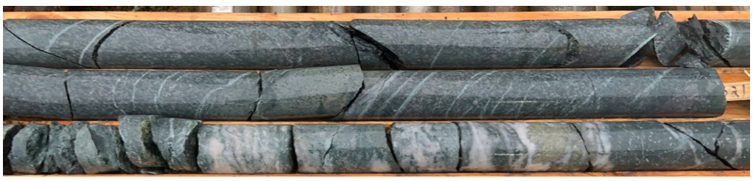
BA-25-006; Close-up view of the vein intersection returning 71.60 g/t Au over 0.60 m.
“Hole BA-25-006 was drilled to test a chargeability anomaly identified by Abitibi Geophysics’ OreVision survey, leading to the discovery of a previously unrecognized mineralized zone outside the historically identified trend.”
— Michael P. Rosatelli, M.Sc., P.Geo., Senior Geological Consultant and Vice-President Exploration, Val-d’Or Mining
Results
The OreVision survey identified several previously untested chargeability anomalies that became priorities for the subsequent drilling campaign. One of these targets, approximately two kilometres west of the historical Arbade Shaft / V2-V7 mineralization trend, was tested by drill hole BA-25-006. The hole intersected two significant gold-bearing zones, including 6.27 g/t Au over 7.4 m, with mineralization hosted in quartz-ankerite veins containing pyrite within a variable altered syenite. Val-d’Or Mining described the discovery as a previously unknown mineralized zone outside the historically identified trend.
The discovery illustrates the value of applying modern deep induced polarization on mature exploration properties. While Baden had been explored for decades, including an earlier Abitibi IP survey in 2004, the enhanced depth penetration and resolution of OreVision generated new drill targets beyond the historical focus, ultimately contributing to the discovery of a new gold zone.
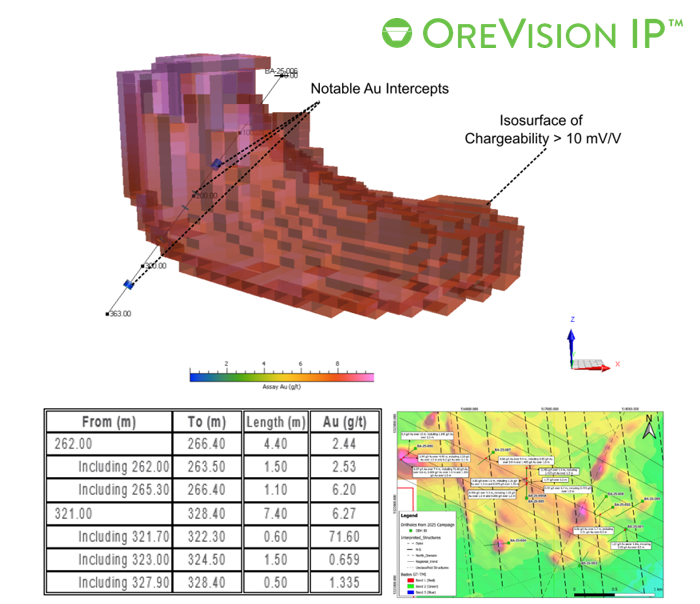
Top: 3D chargeability isosurface from the 2025 OreVision survey showing the chargeability response associated with drill hole BA-25-006, where elevated gold values were intersected.
Bottom left: Assay intersection results.
Bottom right: Baden 2025 Diamond Drillhole Plan Map.


